Outer Banks septic guide
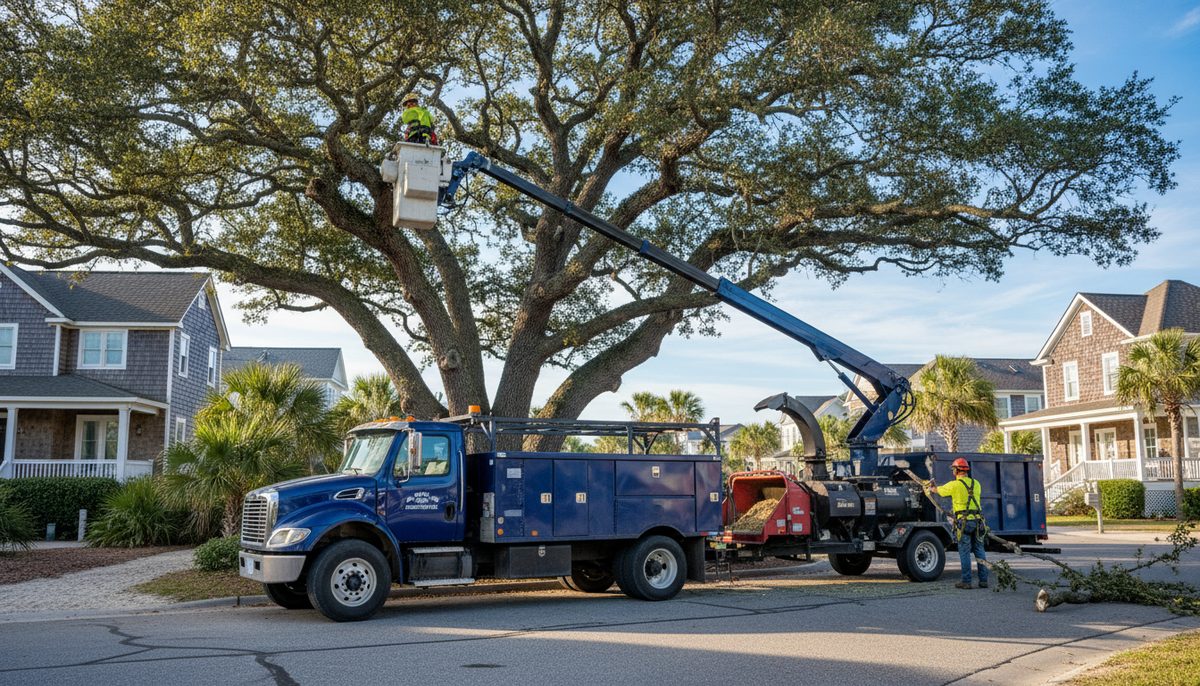
Maritime forest, and why the canopy is not just a collection of trees
Maritime forest is one of North Carolina's most endangered habitat types and the canopy is structural: it shelters itself from salt. What that means for cutting at the edge of a stand.
A maritime forest behaves like one organism with a shared roof. The canopy takes the salt and the wind so the interior does not, and the interior is only able to be forest because the canopy is there. That single mechanical fact is behind nearly everything that feels excessive about tree work near these stands — the scrutiny, the reluctance, the advice to prune where you wanted to remove — and it is worth understanding before you read it as bureaucracy.
The details
Start with how rare the habitat is, because that is where the official attention comes from. The N.C. Wildlife Resources Commission describes maritime forest as 'one of the most endangered habitat types' in the state, and names the cause plainly: coastal development has destroyed much of it. That is an unusual thing for a state agency to write about a habitat that mostly sits on private land, and it is the reason a request to clear an acre of canopy here draws questions that the same request inland would not.
What remains is thin enough to be listed individually. The same NCWRC profile records that the Nags Head Woods maritime deciduous forest is the only good remaining example of Maritime Deciduous Forest, with a further example nearby in Kitty Hawk Woods — and it notes that Maritime Evergreen Forest canopies, dominated by live oak, sand laurel oak and loblolly pine, depend on the canopy itself for protection from salt spray. Two sentences, and between them they explain why the edge trees of a stand are not interchangeable with the interior ones. The edge is the windbreak.
The stands themselves are older and stranger than they look from NC-12. The ~1,900 acres Kitty Hawk Woods reserve is one of the largest remaining maritime forests on the Banks, and its ridges and swales are relict sand dunes marking ancient shorelines; it also holds the state's largest maritime forest where bald cypress dominates the swamp forest community. On a lot cut into that topography, the ridge and the swale are different growing sites a few metres apart — different species, different root zones, different water — and a tree assessment that ignores which one a tree is standing in is guessing.
Removal also changes what grows back, and not in the direction most owners expect. The NCWRC profile notes that storm disturbance produces canopy gaps in Maritime Evergreen Forest and that recently logged sites often return dominated by loblolly pine. Read that as a warning about trade: clear a mixed canopy of oak and pine and the site does not rebuild the mixture, it rebuilds as pine. The oaks that gave the lot its character were the slow half of the system, and nothing about the replacement timeline is within a homeowner's planning horizon.
Public protection of these woods is neither new nor imported. In 1988 the Coastal Resources Commission determined that maritime forest ecosystems should be a high priority for coastal preservation, and what followed — a 1988 state purchase, 152 acres — created the Buxton Woods Coastal Reserve; Dare County established a Special Environmental District for the Buxton area in the same period. Nearly four decades of state and county attention is the context any conversation about cutting near a reserve boundary starts inside, whether or not the parcel in question is regulated.
None of which means the answer is always no. It means the useful question changes from whether a tree can come out to what the gap will do. Taking an interior tree in a closed canopy is a small event; taking the windward edge tree is an intervention on the shelter of everything behind it. Crown reduction on a leaning edge oak, removal of a dead pine from the middle of a stand, and phasing work across seasons are all ways to get the hazard down without opening a hole the salt comes through — and they are what a crew that works these woods regularly will propose first.
Ask what the canopy does before asking what the tree costs. On this coast the trees hold the site together against wind and salt, the interior cannot survive being made into an edge, and the stand that grows back after a full clearing is not the stand that was there.
On the record: 'one of the most endangered habitat types' (NC Wildlife Resources Commission — Maritime forest/shrub community profile (ncwildlife.gov, retrieved 2026-09-17)) · Nags Head Woods maritime deciduous forest (NC Wildlife Resources Commission — Maritime forest/shrub community profile (ncwildlife.gov, retrieved 2026-09-17)) · storm disturbance produces canopy gaps (NC Wildlife Resources Commission — Maritime forest/shrub community profile (ncwildlife.gov, retrieved 2026-09-17)) · 1988 state purchase, 152 acres (NC DEQ — Buxton Woods Reserve (deq.nc.gov, retrieved 2026-09-17)) · ~1,900 acres Kitty Hawk Woods (NC DEQ — Kitty Hawk Woods Reserve site brochure (deq.nc.gov, retrieved 2026-09-17))
Hand-verified 2026-09-17 against the primary sources named above; where a fact could not be verified it was left out, never guessed.