Outer Banks septic guide
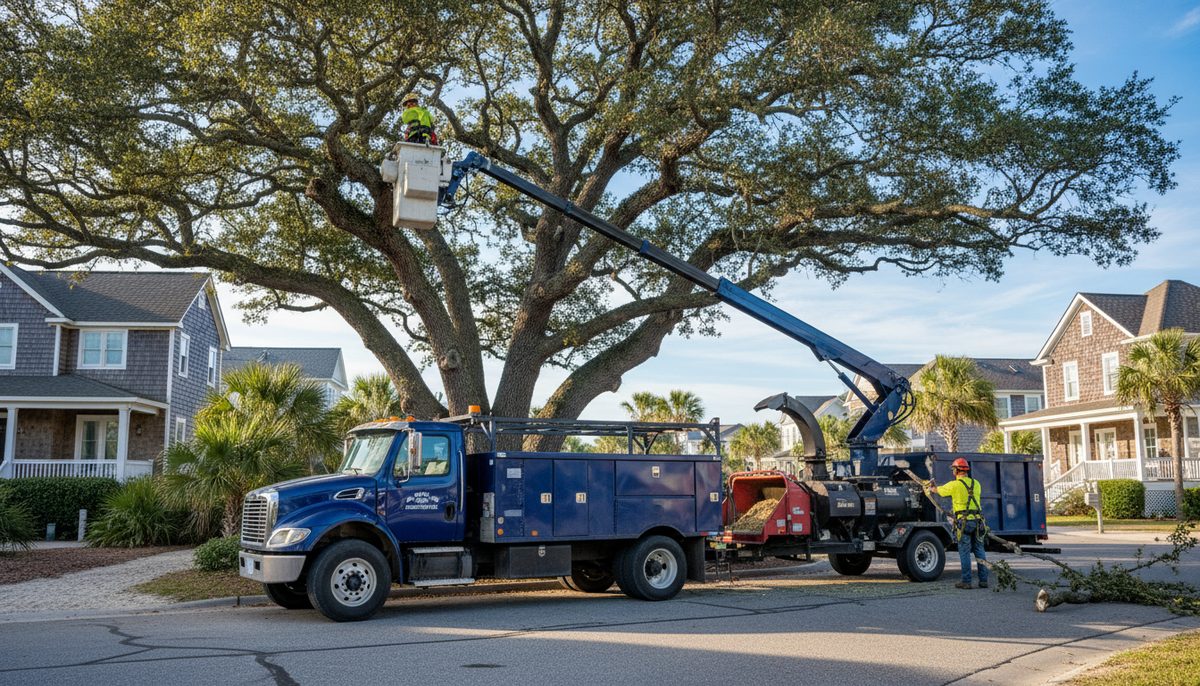
Where tree debris goes in Dare County
Dare County's residential yard debris site draws a hard line at 4 inches in diameter and 3 feet in length, with no stumps and no lot-clearing material. Everything above that goes to Manns Harbor.
Disposal is the part of a tree job people price last and discover first. The wood does not disappear when the saw stops; it becomes a volume of material with a destination, and in Dare County the destination is decided by two measurements and one question about whether the material came off a lot being cleared. Knowing where the lines fall tells you, before you get a quote, roughly how much of your job is cutting and how much is hauling.
The details
The residential yard debris site sets the boundary. It takes vegetative debris brought in a pickup truck or a small single-axle trailer of about four feet by eight, and it applies a firm 4-inch diameter, 3-foot length limit: no stumps, nothing over four inches in diameter, nothing over three feet long, and no lot-clearing materials at all. Larger jobs are directed to the C&D landfill in Manns Harbor. Every one of those conditions is a size or source restriction rather than a fee question, which is why arguing with them at the gate does not work.
The logic behind the limits is worth seeing, because it makes them memorable. That site is sized for what a household generates — hedge trimmings, storm twigs, a pruned limb — and for material a person can lift and a small machine can process. A twenty-inch trunk section is neither. Once you understand it as a household-scale facility rather than a small landfill, the exclusions stop looking arbitrary and start predicting themselves.
Above the line, the county's own facilities are still where the material goes, but the door changes. The recycling centre at 1018 Driftwood Drive, Manteo, reachable on 252.475.5890, accepts vegetative materials along with recyclables, while the C&D landfill and transfer station in Manns Harbor on US 264 at 252.473.2059 accepts all sorted materials — including the larger tree debris and the land-clearing material the residential site will not take. Sorted is the operative word in that sentence: mixed loads are a different and worse conversation at the scale house.
Now the arithmetic that decides your quote. A single mature loblolly cut into pieces no longer than three feet is not one trailer load, it is many, and each one is a round trip down a two-lane road shared with holiday traffic. That is the real reason a removal costs what it costs on a barrier island: the cutting is an hour of skill and the hauling is a day of logistics. A contractor who names the disposal route in the quote is telling you they have counted the trips; one who leaves it vague has either absorbed the cost or plans to discover it.
Stumps deserve their own paragraph because they are excluded from the residential site by name, and because that exclusion drives a decision most owners are not expecting to make. A stump can be ground in place, which leaves chips and a root mass to rot down slowly, or it can be excavated and hauled, which is heavier work and produces material with soil and sand in it that no vegetative-only facility wants. On sandy coastal soils grinding is often the proportionate answer, and it removes the disposal problem rather than relocating it.
One exception runs the other way, and only sometimes. After a declared storm the county switches to a right-of-way collection in four separate debris piles and residential material is picked up from the verge instead of delivered. That is an emergency programme with a beginning and an end, it does not apply to routine work, and it does not apply to commercial haulers, who use the transfer stations and pay tipping fees. Outside a declared event, material left on the road is just material left on the road.
Four inches and three feet is the line, stumps and lot-clearing material are out, Manns Harbor takes what the residential site will not, and every load is a round trip somebody is paying for. Ask where the wood is going before you ask what the job costs — the answers are the same answer.
On the record: 4-inch diameter, 3-foot length limit (Dare County — Residential Yard Debris (darenc.gov, retrieved 2026-09-17)) · 1018 Driftwood Drive, Manteo (Dare County — Storm Debris Removal news notice (darenc.gov, retrieved 2026-09-17)) · four separate debris piles (Dare County — post-storm reentry/debris notice (darenc.gov, retrieved 2026-09-17))
Hand-verified 2026-09-17 against the primary sources named above; where a fact could not be verified it was left out, never guessed.